4-Way Stop Rules: Who Has the Right of Way?
We’ve all been there. That moment when you come to a 4-way stop and aren’t sure who has the right of way. It can be frustrating, but more importantly, it can be dangerous. Below, our driving instructors break down exactly who goes first in every situation, from two cars arriving together to pedestrians in the crosswalk, so you can drive through any intersection with confidence.
The short answer: At a 4-way stop, the first vehicle to come to a complete stop goes first, often called “first to stop, first to go.” If two vehicles stop at the same time, the driver on the left yields to the driver on the right. If two vehicles are facing each other, the vehicle going straight or turning right goes before the vehicle turning left. Pedestrians in a crosswalk always go first.
What Is a 4-Way Stop (All-Way Stop)?
A 4-way stop is an intersection where traffic from all four directions must come to a complete stop. You’ll recognize one by the small sign under each stop sign that reads “4-WAY” or “ALL WAY.” An all-way stop works the same way whether three, four or more roads meet.
Don’t confuse a 4-way stop with an uncontrolled 4-way intersection, which has no signs or signals at all. At an uncontrolled intersection, you slow down, prepare to stop and yield to vehicles already in the intersection or approaching from your right. If only some directions have stop signs (a 2-way stop), cross traffic without a stop sign has the right of way.
What Does “Right of Way” Mean?
“Right of way” describes who should go first when two road users (drivers, cyclists or pedestrians) want the same space at the same time. Here’s the part many new drivers miss: traffic laws don’t actually give anyone the right of way. They only say who must yield it. That’s why defensive drivers never assume another driver will yield, even when the law says they should.
In Illinois, Ohio and Wisconsin, state law spells out the same basic rule for intersections: when two vehicles arrive at about the same time, the driver on the left yields to the driver on the right. (See the Illinois Vehicle Code, 625 ILCS 5/11-901, Ohio Revised Code 4511.41 and Wisconsin Statute 346.18.)
Rule 1: First to Stop, First to Go

The first vehicle to arrive at the intersection has the right of way. It doesn’t matter where the vehicle is located or what direction it is traveling; this rule always applies when someone has clearly arrived at the stop sign first. Even if additional vehicles arrive before the first car passes through, the first to arrive still has precedence. However, watch for aggressive or distracted drivers who may ignore this rule.
What counts as a complete stop? Your vehicle must come to a full stop (no rolling) at the white stop line. If there’s no stop line, stop before the crosswalk. If there’s no crosswalk, stop before entering the intersection at the point where you can see approaching traffic.
Who Has the Right of Way If Two Cars Arrive at the 4-Way Stop at the Same Time?
When multiple vehicles reach a 4-way stop at the same time, there are 3 rules of the road you must follow to understand who should go through the intersection first:
1. Always yield to the right
When two vehicles arrive at a 4-way stop at the same time side-by-side, the vehicle furthest to the right has the right of way.
2. Straight traffic goes before turning traffic
When arriving at an intersection head-to-head with another vehicle, it is important to use signals. When two vehicles arrive at a 4-way stop at the same time, facing each other, and one intends to turn while the other intends to go straight, the vehicle going straight has the right of way. Keep in mind that if both vehicles are going straight or turning in the same direction, they can both proceed at the same time, as they will not cross each other’s path.
3. Right turns go before left turns
When two vehicles arrive at a 4-way stop at the same time, facing each other, and one intends to turn right while the other intends to turn left, the vehicle turning right has the right of way. Move forward slowly before entering the intersection to show other drivers you are making the turn. The driver turning left should wait until the other car has fully passed.


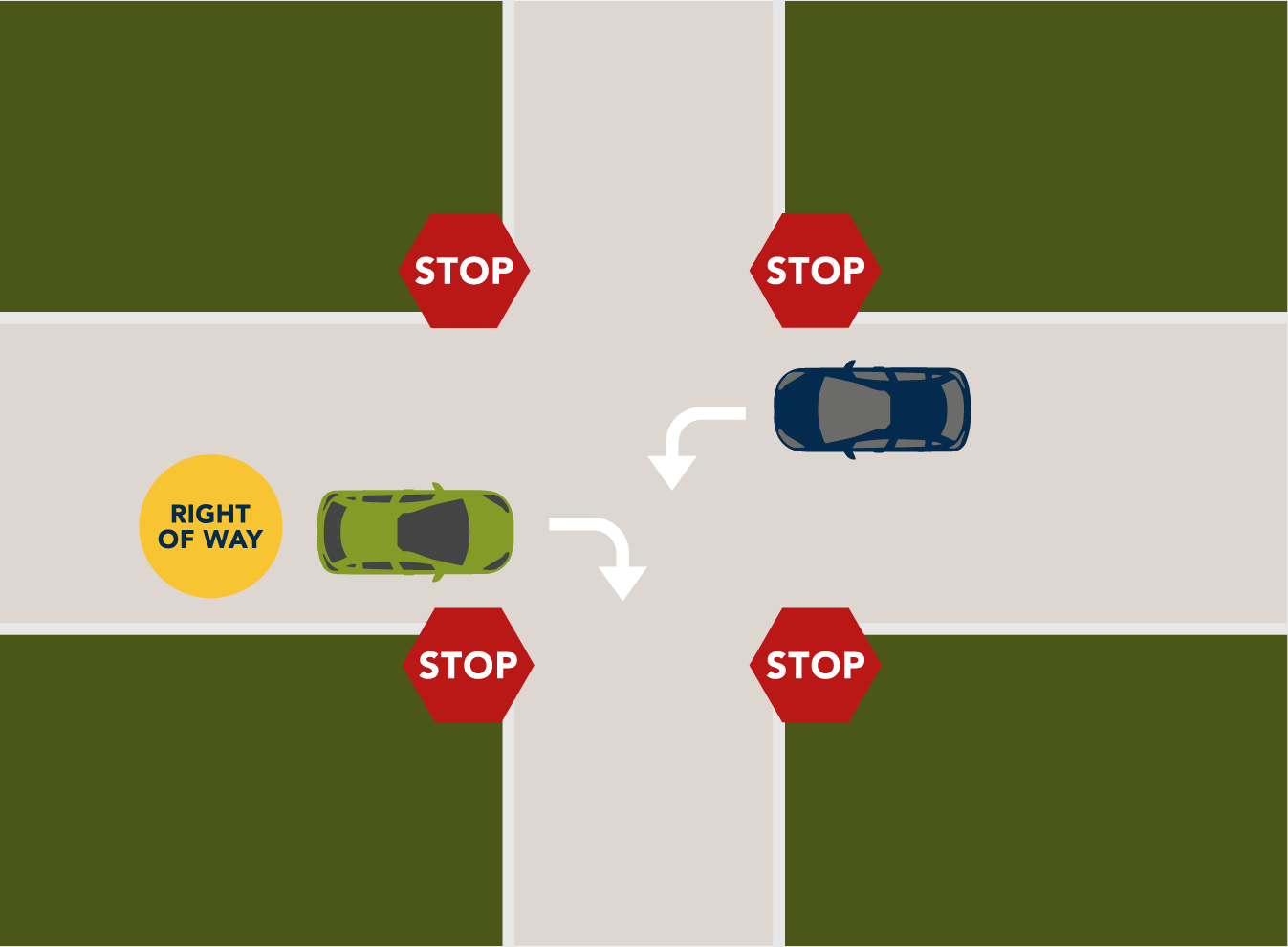
Who Goes First If Three Cars Arrive at the Same Time?
Apply the yield-to-the-right rule one car at a time. With three cars, one of them will have no vehicle directly on its right, so that driver goes first. Then the next driver who no longer has a car on their right goes, and so on. If two of the three cars are facing each other, use the straight-before-turning and right-before-left rules above to break the tie. Always signal so other drivers know your plan.
Who Has the Right of Way If 4 Cars Arrive at a 4-Way Stop at the Same Time?
There is no designated rule for who should go first. Because every driver has a car on their right, the yield-to-the-right rule creates a standstill. The safest approach is to communicate: make eye contact, and if another driver clearly waves you on, proceed slowly and watch them the whole way through. If no one moves, a driver may carefully take the lead, creeping forward slowly and stopping if anyone else goes. Once one car clears the intersection, use the rules above to sort out the rest.
How to Drive Through a 4-Way Stop: Step by Step
- Signal early. Turn on your signal at least 100 feet before the intersection so other drivers know where you’re headed.
- Come to a complete stop at the stop line, crosswalk, or edge of the intersection.
- Note who arrived before you and who arrives at the same time.
- Check for pedestrians and cyclists in or near every crosswalk.
- Wait your turn, using first-to-stop, yield-to-the-right, straight-before-turning, and right-before-left.
- Look left, right, and left again, then proceed steadily. Don’t stop partway through.
4-Way Stop Rules for Bicyclists and Pedestrians
In most states, bicyclists are considered vehicles and have the same rights and responsibilities as motorists. Illinois requirements state that bicyclists must come to a complete stop, yield to any traffic with the right of way, and signal their intention to turn when navigating a 4-way stop. It is recommended that bicyclists make themselves visible with proper lighting and reflective gear, especially at night.
While most states prioritize pedestrian safety by granting them the right of way, a proactive approach benefits everyone. Drivers should always be prepared to yield, keep a safe distance and stay alert, especially around crosswalks. In Illinois, vehicles are required to yield to pedestrians at 4-way stops. Pedestrians are encouraged to take proactive steps before crossing, like making eye contact with drivers. Prioritizing pedestrian safety isn’t just a legal requirement; it’s a shared responsibility that creates a safer environment for everyone.
Example: You and the car on your right stop at the same time, and a pedestrian is crossing in front of that car. Who goes first? (1) The pedestrian, (2) the car on your right, (3) you.
4-Way Stop Rules at a Glance
| Situation | Who goes first |
|---|---|
| One car arrives first | The first car to come to a complete stop |
| Two cars arrive at the same time, side by side | The car on the right |
| Two cars facing each other: one straight, one turning | The car going straight |
| Two cars facing each other: one turning right, one turning left | The car turning right |
| Three cars arrive at the same time | The car with no vehicle on its right, then continue yielding to the right |
| Four cars arrive at the same time | No legal rule. Communicate with eye contact; one driver carefully takes the lead |
| A pedestrian is in the crosswalk | The pedestrian, always |
Common 4-Way Stop Mistakes to Avoid
- Rolling stops. Slowing down without fully stopping is one of the most common reasons new drivers fail their road test, and it can get you a ticket.
- Waving others through when it’s your turn. It seems polite, but it can confuse drivers behind you and other drivers at the intersection. Take your turn when it’s clearly yours.
- Assuming the other driver will yield. Make eye contact and watch the other car’s wheels before you go.
- Forgetting to signal. Without a signal, other drivers can’t apply the straight-before-turning rule.
- Missing pedestrians. Check every crosswalk, including the one you’re turning into.
4-Way Stop FAQs
Do you have to stop at a 4-way stop if no one else is there?
Yes. You must come to a complete stop every time, even if the intersection is empty.
What is the “first to stop, first to go” rule?
It’s the basic 4-way stop rule: whoever comes to a complete stop first gets to go first, no matter which direction they’re coming from or where they’re headed.
Who has the right of way at an intersection with no signs?
At an uncontrolled intersection, yield to vehicles already in the intersection and to vehicles approaching from your right. Slow down and be ready to stop.
What should you do at a flashing red light or a traffic signal that’s out?
Treat a flashing red light like a stop sign. If the signals are dark at an intersection, treat it like an all-way stop and follow the same 4-way stop rules.
Do pedestrians always have the right of way at a 4-way stop?
Drivers must yield to pedestrians in a crosswalk. Pedestrians should still make eye contact with drivers and never assume a car will stop.
Practice 4-Way Stops With a Top Driver Instructor
Knowing the rules is step one. Confidently applying them in real traffic takes practice. Top Driver’s state-certified instructors coach new drivers through 4-way stops, busy intersections, and everything else they’ll see on their road test.
- Teens: Illinois drivers ed · Ohio drivers ed · Wisconsin drivers ed
- Adults: Illinois adult driving lessons · Ohio adult driver education
- Road test coming up? See what to expect on the Illinois driving exam or book an Illinois road test with Top Driver.
Find a Top Driver location near you →
Keep learning: Check out our full list of safe driving tips, learn how to make a right turn on red, brush up on what each traffic signal color means, or contact us with questions.
Frequently asked questions
Who has the right of way at a 4-way stop?
Whichever vehicle came to a complete stop first has the right of way. This rule resolves the majority of 4-way stop scenarios. The key is 'complete' stop — a rolling 'California stop' doesn't count.
If two cars arrive at a 4-way stop at the same time, who goes first?
The vehicle on the right has the right of way. The driver on the right has the longer view across the intersection of cross-traffic, so giving them priority lets them clear faster.
If two cars arrive at the same time from opposite directions, who goes first?
The vehicle going straight has the right of way over the vehicle turning. A turning vehicle yields to the oncoming straight-through vehicle. If both are turning the same direction, they can both proceed because their paths don't cross.
What if drivers at a 4-way stop are confused about who has the right of way?
Make eye contact and wave the other driver through. Don't argue right-of-way at a 4-way stop — the few seconds you save aren't worth a crash. Defensive driving means acting on what other drivers actually do, not what they're supposed to do.